All awards & honors
Share:
RecognitionUniversity levelStartup
FPT students develop an NVIDIA Jetson-based smart-farm monitoring system
FPT University Ho Chi Minh City artificial-intelligence students developed a Smart Farm Management System to help pig farms monitor animals and manage time and costs as conventional farms adopt industrial-scale production.
- Competition
- FPT Student Startup
- Organizer
- FPT University HCM Business Relations
- Campus
- HCMC
- Date
- Dec 25, 2024
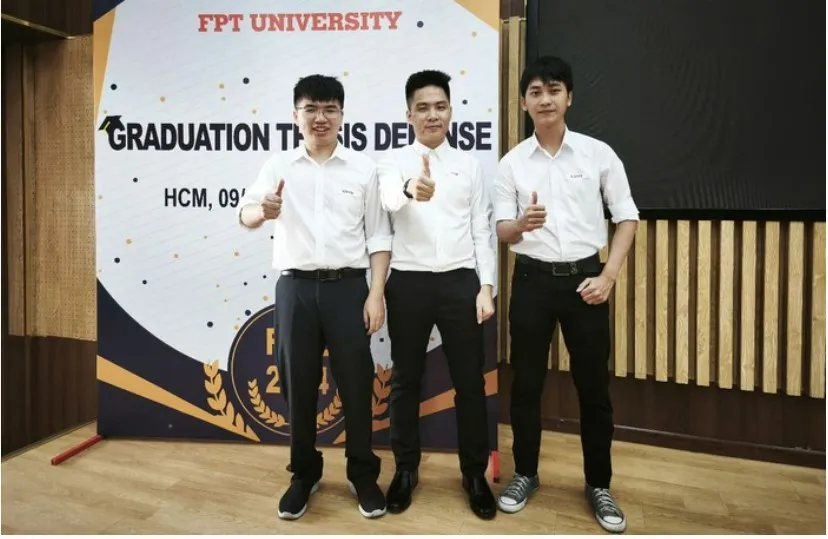
FPT University Ho Chi Minh City artificial-intelligence students developed a Smart Farm Management System to help pig farms monitor animals and manage time and costs as conventional farms adopt industrial-scale production.
The system runs AI and computer-vision models on NVIDIA Jetson Orin Nano. It is designed to count pigs, analyse behaviour, estimate weight and detect possible health issues in real time. A tuned YOLO model detects, identifies and classifies pigs, while tracking algorithms maintain animal IDs. Movement analysis classifies behaviour such as walking, standing, lying and eating. The team also tested Vision Transformer methods for visible abnormal behaviours such as aggression or biting.
The team described the technology as still in development. A trial was conducted at a pig farm in Dong Nai. Weight estimation combines YOLO image segmentation and body-area measurement with five body landmarks — head, neck, back, hindquarters and tail — to estimate posture and geometry. An artificial neural network estimates weight from body area, length and back curvature. The model was trained on 174 pigs, each weighed five times.
For visible skin abnormalities, the team fine-tuned ResNet50V2 to classify pigs as normal or showing visible irregularities. Training used 4,000 images from a Dong Nai farm and academic sources.
Initial tests reported accurate counting, with difficulties when animals were occluded or far from the camera. Weight-estimation error was reported below 10% across different conditions. The source notes that image-based detection cannot identify diseases without visible symptoms. The system is not presented as a substitute for veterinary assessment.
The student developers named in the article are Nguyen Phan Nhat Minh, Nguyen Hoang Anh and Le Lam Nhat Linh. Lecturer Nguyen Quoc Trung said the system could reduce the time and cost of safe isolation processes and support earlier detection of unusual herd conditions.
The team planned to improve the system, add multi-class disease recognition and combine behavioural and biometric data to improve assessment. Further work would be needed before expanding across species and farm settings. Article credit: Giao Duc Viet Nam. All results are those reported in the original article.
Source: Official Proof / Certificate URL · FPT University HCM Business RelationsRead original article