All awards & honors
Share:
RecognitionUniversity levelStartup
Medibox: an FPT student HealthTech project connecting families through medication reminders
As chronic illness, busy schedules and older people's dependence on medication increase the challenges of home medicine management, FPT University students developed Medibox, an IoT-connected smart pillbox. The team wanted timely medication reminders to become a practical expression of family care as well as a technical function.
- Competition
- FPT Student Startup
- Organizer
- FPT University HCM Business Relations
- Campus
- HCMC
- Date
- Sep 16, 2025
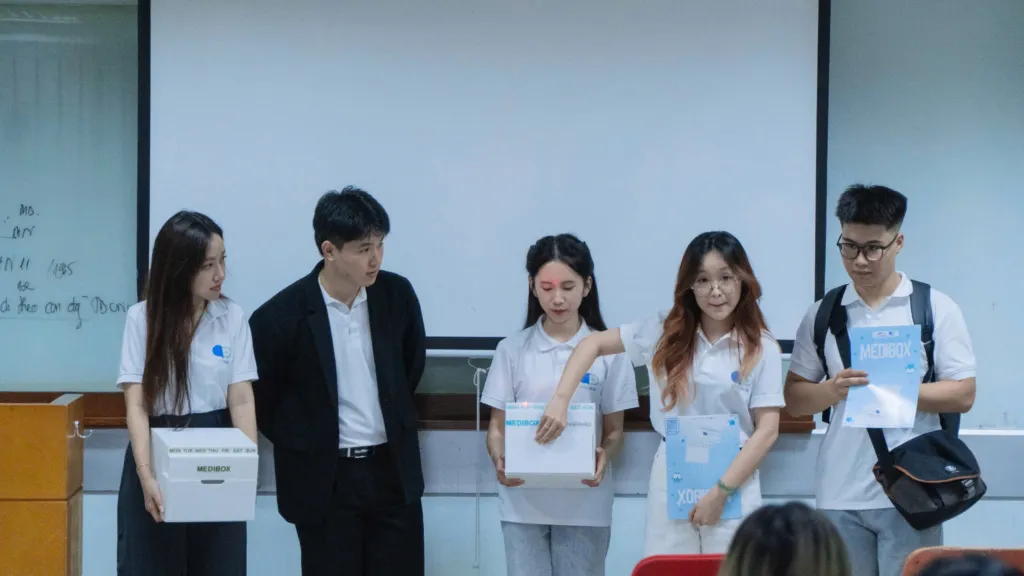
As chronic illness, busy schedules and older people's dependence on medication increase the challenges of home medicine management, FPT University students developed Medibox, an IoT-connected smart pillbox. The team wanted timely medication reminders to become a practical expression of family care as well as a technical function.
Team G69 comprised International Business and Marketing students Le Thi Linh, Nguyen Duc Manh, Pham Ha Thu, Hoang Viet Cuong and Nguyen Mai Linh. They described seeing parents and grandparents struggle to remember several medicines, leaving relatives worried, especially when living far away. Their proposed solution combined simple reminders with remote monitoring.
The project began in March 2025 as a practical graduation assignment. Research and user conversations persuaded the team to develop a real product. The source describes three distinguishing features: reminders recorded in a relative's voice, LED and TFT-display guidance to the appropriate compartment, and IoT synchronisation with a mobile application so relatives or doctors can review the recorded information remotely.
The message 'Medibox — one reminder, a thousand expressions of care' captures the team's intention to make technology a connection rather than a barrier. Familiar voices and illuminated compartments aim to make reminders easier to understand and less impersonal, while supporting proactive care and everyday quality of life.
Development required months of researching older adults' medication habits and the difficulties experienced by people with chronic conditions. The team repeatedly tested the correct compartment lighting, sound clarity, unobtrusive alerts and smooth app synchronisation. It revised designs and code and worked through prototypes that did not meet expectations.
Team member Le Linh identified technology and funding as major difficulties. Not everyone had an engineering background, so hardware engineers helped with the prototype. Research, trial production and communication costs required careful choices. Some older users were unfamiliar with technology or did not prioritise following medication schedules, making ease of use essential.
The team adopted an 'easy to use first, smart second' principle. A medication schedule entered in the app triggers sound and light reminders. The connected app can notify relatives when medication has not been taken according to the recorded schedule. These are product functions described by the source, not independently verified clinical outcomes.
During two months of Facebook and TikTok communication, the source reports more than 40,000 views or reach and nearly 2,000 followers. Campaigns included a commercial whose message was remembering at the right moment, mini-games and community challenges. Trial sales totalled 67 products and more than VND 32 million in revenue, with Medibox Pro accounting for a substantial share.
Some customers purchased after demonstrations at pharmacies or community events, or through word of mouth. The article presents these early results as indications of feasibility for a student project, while recognising that they are still small in the wider market.
Supervisor Nguyen Duy Hong supported the team from the outset with professional direction, technical problem-solving and encouragement to remain persistent and responsible for the product. The article also credits FPT University's practical, innovation-oriented learning environment.
G69's longer-term ambition was a broader health-management platform connected with healthcare systems, insurance and home-care services, followed by expansion into Southeast Asia and eventually other markets. The original article presents this as a future aspiration, grounded in the team's wish to translate family concern into tangible everyday support.
Original image captions describe the graduation defence, family connection, accessibility for older and ill users, and hopes for domestic and international expansion. Article credit: FPT University.
Source: Official Proof / Certificate URL · FPT University HCM Business RelationsRead original article